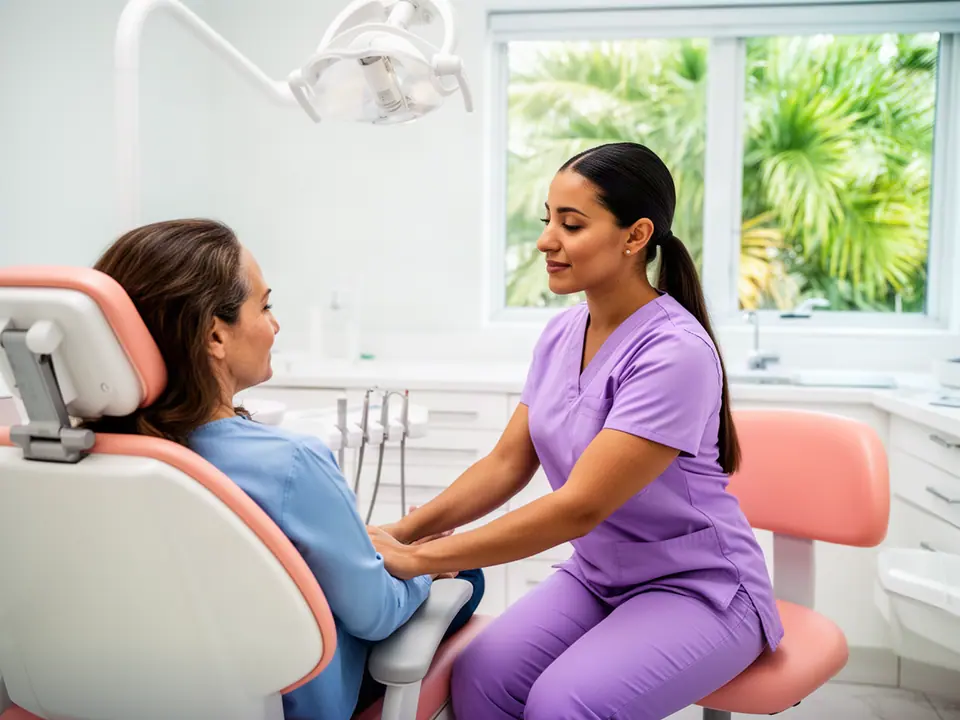
The terms a Florida City, FL dental office is offered depend on its collections and overhead, what the money buys, the owner's credit and the term requested. Millview Funding passes the request to funding partners, and each one sets its own rate and term after review, so two offers on the same office can differ.
What shapes dental office loan terms in Florida City, FL, with invented collections, equipment-split and buy-in examples.
Collections, overhead and other numbers that shape the terms
A dental office's loan terms start with its own numbers. Collections, the money the office actually received, count for more than production, the fees it billed. Overhead, existing loan payments and the insurance mix come next, because they set how much of each collected dollar is left over for a new payment.
Invented figures for illustration, not an offer: an office collects $92,000 a month and runs at 64% overhead, or $58,880. That leaves $33,120 before debt payments and the dentist's own pay. A new payment of $2,600 would take 2.8% of collections. A partner looking at those figures can also weigh the owner's credit, the age of the practice and the size and term of the request.
Staff pay is a large part of that overhead. County Business Patterns put payroll at offices of dentists in Miami-Dade County, FL at $424.2 million for 2023, across 8,231 employees in the March pay period (NAICS 6212): about $51,537 per employee on our arithmetic. An office adding a hygienist adds to that line before the new chair collects anything.
Equipment loans versus a term loan for an office update
An office update has two kinds of cost. Equipment, such as a cone-beam CT unit, an intraoral scanner or new operatory chairs, has resale value and can secure an equipment financing note. Freestanding cabinetry, supplier setup and staff training can be reviewed separately from fixed plumbing, design and installation work, which are not funded through this site. The practice can compare a term loan with equipment financing for those movable items. Financing both on one term loan is simpler; splitting them can cost less, when the equipment note carries a lower rate.
Invented example, not an offer: a $96,000 imaging unit and $31,000 of soft costs. Financed together on one $127,000 note at 11% a year for 60 months, the office in this example would pay $2,761.29 monthly, or $165,677.40 by the last payment. Split instead, the imaging unit at 9.25% costs $2,004.47 a month and the soft costs at 11% cost $674.02, $2,678.49 together and $160,709.40 over the term.
In this example the split saves $4,968.00 over five years. The saving depends on the rate gap; if the equipment note carries a higher rate, or a fee the term loan does not, it can disappear. The dental practices page covers refinancing an older office loan and orthodontic equipment packages. Ask each vendor whether installation and training appear on the equipment invoice, since that decides which side of the split they fall on.
Buying into an existing dental practice
An associate buying into an existing practice pays for a share of its patients, its collections and its equipment. The price comes from a valuation, which reads collections over several years, the active patient count, the equipment's age and the lease. If the building is part of the sale, that piece is real estate, which Millview Funding does not arrange; the funding here is for the practice share itself.
A buy-in can be split between outside funding and a note from the selling dentist. Invented example, not an offer: a $210,000 share, with $150,000 on a term loan over 72 months at 10% a year and $60,000 on a seller note over 36 months at 6%. The loan payment is $2,778.88 and the note payment $1,825.32, so the buyer pays $4,604.20 a month for the first three years and $2,778.88 after the note is paid.
The buyer's share of profits after the buy-in has to carry both payments in those first three years. A partner can ask for the practice's last three years of returns, the buy-in agreement and the associate's own collections to see whether it does. The agreement also matters for the terms: how long the selling dentist stays on, who keeps which patients, and what happens to the note if either dentist leaves early are all questions to settle before a lender reads it.
Questions to ask about any dental loan offer
Two offers on the same dental office can differ in more than the rate. Before choosing, put each offer's answers to these questions side by side:
- Is the price stated as an annual rate or as a factor rate on a fixed total?
- Added up from first installment to last, what does the office pay?
- Which fees are taken from the funds at closing, and which are billed later?
- Can the loan be paid off early, and is there a penalty for doing so?
- What secures it: only the equipment being bought, or a lien on all business assets?
- Does it require a personal guarantee, and from whom?
- What happens if the office moves to a new lease before the loan ends?
Write the answers down for each offer; a lower rate with a blanket lien and a prepayment penalty can be a worse fit than a slightly higher rate with neither. Further articles on funding for practices are on the blog.
By Millview Funding · Updated